
300-yard fairway drive vs. sinking every putt inside 10 feet
August 2026 · 9 min read
It's an old argument: would you rather hit a guaranteed 300-yard drive in the fairway every time, or sink every putt inside 10 feet? It sounds like a matter of taste, but it isn't. We have shot-by-shot data on thousands of logged rounds, so we simulated both superpowers over 1,000+ complete 18-hole rounds and counted the strokes. Then we ran a third version, where the 300 yards comes without the guaranteed fairway, and the answer flipped.
The setup
Two superpowers, applied to real rounds exactly as logged:
- The fairway drive. On every par 4 and 5 longer than 320 yards, your tee shot finishes 300 yards out, in the fairway. On holes under 320 you finish 20 yards from the pin, in the fairway. Never the rough, never a hazard, never out of bounds. Par 3s are untouched.
- The putting. The first putt you face inside 10 feet on each hole goes in. Every time, no misses.
Rounds are grouped by their USGA score differential, which is how the round actually played rather than what the golfer set their target handicap to. One note before the numbers: a single-round differential is not a handicap index, since an index is your best 8 of 20. A round that plays to a 10 differential is roughly what a 7 or 8 index shoots on a normal day.
The result: the drive wins everywhere
We expected a crossover. The common intuition is that distance matters for good players and short putts matter for everyone else, so somewhere up the handicap scale putting should take over. It never does.
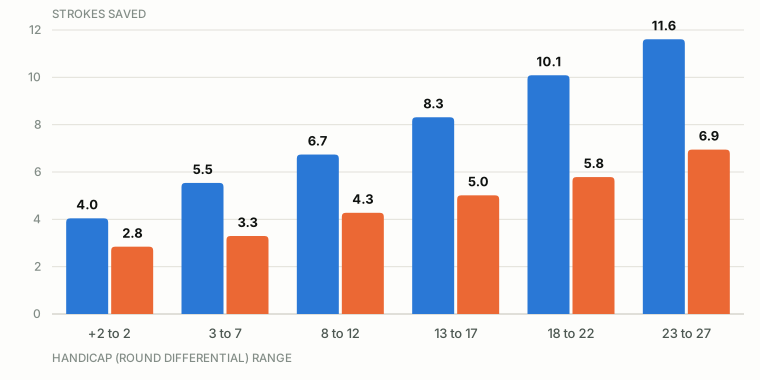
The drive wins by 1.4 to 1.7 times in every single band. Both superpowers get more valuable as the golfer gets worse, which is expected, but the drive scales faster: it nearly triples from the scratch band to the 23 to 27 band, while putting grows by about two and a half times.
| Handicap (round differential) range | Avg score | 300 yard fairway drive shots saved | Sink 10 ft putts shots saved | Drive wins | Avg real drive |
|---|---|---|---|---|---|
| +2 to 2 | 72.3 | 4.0 | 2.8 | 69% | 265 yds |
| 3 to 7 | 76.6 | 5.5 | 3.3 | 84% | 255 yds |
| 8 to 12 | 81.4 | 6.7 | 4.3 | 82% | 245 yds |
| 13 to 17 | 86.1 | 8.3 | 5.0 | 90% | 233 yds |
| 18 to 22 | 90.6 | 10.1 | 5.8 | 93% | 216 yds |
| 23 to 27 | 94.6 | 11.6 | 6.9 | 85% | 202 yds |
"Drive wins" is the share of individual rounds where the drive saved more than the putting would have. Even in the scratch band, where the case for putting is strongest, the drive still wins more than two rounds in three.
A forced 300 sometimes makes things worse
The premise says exactly 300 yards, every time, and that cuts both ways. On a 340-yard par 4 you finish 40 yards out whether you like it or not. Scratch-level rounds in this data average 265 yards off the tee, so those golfers are often already inside that, and the superpower is a downgrade. We counted those holes as losses rather than quietly discarding them.
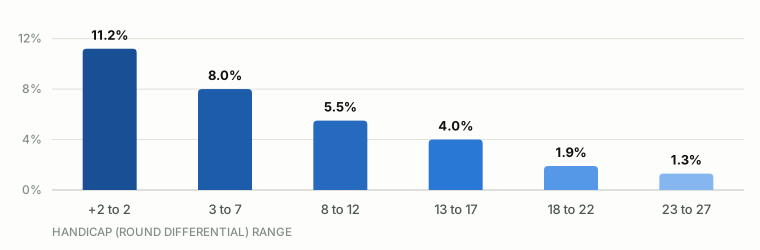
It costs the scratch band real strokes on 11% of their par 4s and 5s, falling steadily to 1.3% for the 23 to 27 band, who average 202 yards off the tee. This is the strongest argument available for the putting side, and it still is not enough to flip a single band average.
Why putting can't catch up
The most surprising number in the study is one that barely moves. Scratch players face a putt inside 10 feet on 16.5 of 18 holes. The 23 to 27 group faces one on 17.3 holes. Essentially identical.
High handicaps do not get more short putts. They face the same ones and miss more of them. That is what caps the putting superpower: there are only so many strokes sitting inside 10 feet, and even a perfect putter can only collect the ones that are actually there.
The tee shot has no such ceiling, because it changes the shape of the whole hole. It also quietly erases every penalty stroke off the tee, which is worth 1.3 strokes per round on its own in the 18 to 22 band, against 0.3 for scratch. For weaker players the perfect drive is as much an accuracy superpower as a distance one, and that is most of the story.
Take the fairway away and it flips
That last claim is testable, so we tested it. Same rounds, same rule, one change: the drive still advances 300 yards, but it finishes in whatever lie your real tee shot found. A 200-yard drive into the rough becomes a 300-yard drive still in the rough. Penalties still happen, the ball just travels 300 yards before it finds them.
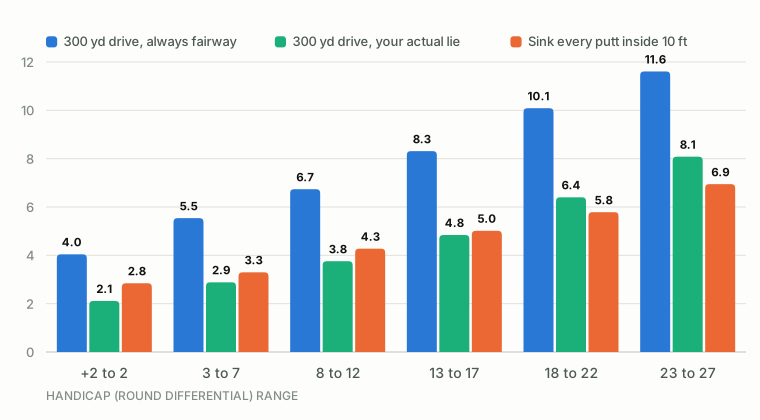
That flips the answer. Putting wins in every band up to a 17 differential, and the drive only survives at 18 and above. The crossover we went looking for in the original question is real after all. It was hiding behind the guaranteed fairway.
| Handicap (round differential) range | 300 yards, always fairway | 300 yards, your actual lie | Sink 10 ft putts | Actual lie, as % of fairway |
|---|---|---|---|---|
| +2 to 2 | 4.0 | 2.1 | 2.8 | 52% |
| 3 to 7 | 5.5 | 2.9 | 3.3 | 52% |
| 8 to 12 | 6.7 | 3.8 | 4.3 | 56% |
| 13 to 17 | 8.3 | 4.8 | 5.0 | 58% |
| 18 to 22 | 10.1 | 6.4 | 5.8 | 63% |
| 23 to 27 | 11.6 | 8.1 | 6.9 | 70% |
The bolded figure in each row is the winner between the realistic drive and the putting. Note how close 13 to 17 is: 4.8 against 5.0 is a coin flip, which is exactly where you would expect a crossover to sit.
The last column is the interesting one. The guaranteed fairway is worth about half the whole superpower, and it is worth more to better players: the same-lie drive keeps 52% of the fairway version's value in the scratch band, rising steadily to 70% in the 23 to 27 band. Better golfers get more of their gain from the lie, weaker golfers get more of theirs from the raw distance. That is the reverse of the usual intuition, and it is probably the most useful thing in this study.
Dropping the fairway also makes the forced-300 problem worse, because there is no longer a lie upgrade to offset it. A compulsory 300 now leaves scratch-band golfers worse off on 16.2% of their par 4s and 5s, against 11.2% in the guaranteed-fairway version.
Penalties needed a rule of their own here. The superpower belongs to the drive, so on a hole where you found water the ball travels 300 yards before it finds trouble: your drop sits at the 300-yard mark rather than wherever it actually sat, in the same lie, and the shot you play from there is left exactly as you played it.
That is a move to 300 yards, not a move of 300 yards, and the difference is large. The average penalty drop in this data already sits 226 yards down the hole, so the ball only moves forward about 70 yards, and 7.5% of the time the real drop was already past the 300 mark, which moves it backwards and counts as a loss. Stroke and distance is the exception, since a re-tee sends you back to the tee no matter how far the ball went, so there the re-teed ball is the one that gets the 300.
How this was measured
Replacing a tee shot changes what you face next, and we cannot replay an approach shot you never hit. So the rest of the hole is valued at your own handicap-calibrated expected strokes from the new position. That is standard strokes gained logic, and it is why the driving figure is an expectation rather than a literal recount.
Putting we can also count literally, and we ran it both ways as a check. The two methods agreed closely, which is a good sign the model is behaving.
Only complete rounds with 18 scored holes were used, with the shot count matching the hole score, exactly one holed shot per hole, and a real tee shot on every par 4 and 5. No golfer contributes more than three rounds to any band, so no single player skews a result. Re-deriving strokes gained from the raw shots reproduced the stored round totals for 99.7% of rounds, and three different sampling designs moved the headline numbers by at most 0.3 strokes. A handful of holes cannot be priced under the same-lie rule at all, a drive that finished on the green being the common case, and those 0.3% are dropped rather than guessed at.
What to actually do with this
Nobody is handing out superpowers, so the practical read is about where your own strokes are hiding. The reason the drive wins is not really the 300 yards, it's the fairway. Penalty strokes and recovery shots off the tee are the single largest recoverable pool for most amateurs, and they compound: a bad drive costs you the stroke plus the position plus the pressure on the next shot.
Which half of that you should care about depends on where you are. If your rounds play to better than about a 17 differential, a realistic 300 yards is worth less to you than never missing a short putt, and the work that pays is whatever keeps the ball on the short grass. If you play above a 17, distance still wins even without the guaranteed fairway, largely because it shortens the holes where you are currently making a 7.
That said, this is a study of averages across handicap bands, and you are not an average. The only way to know whether your strokes are leaking off the tee, on approach, around the green, or on the putting surface is to measure your own rounds. Three tracked rounds is enough to find out.